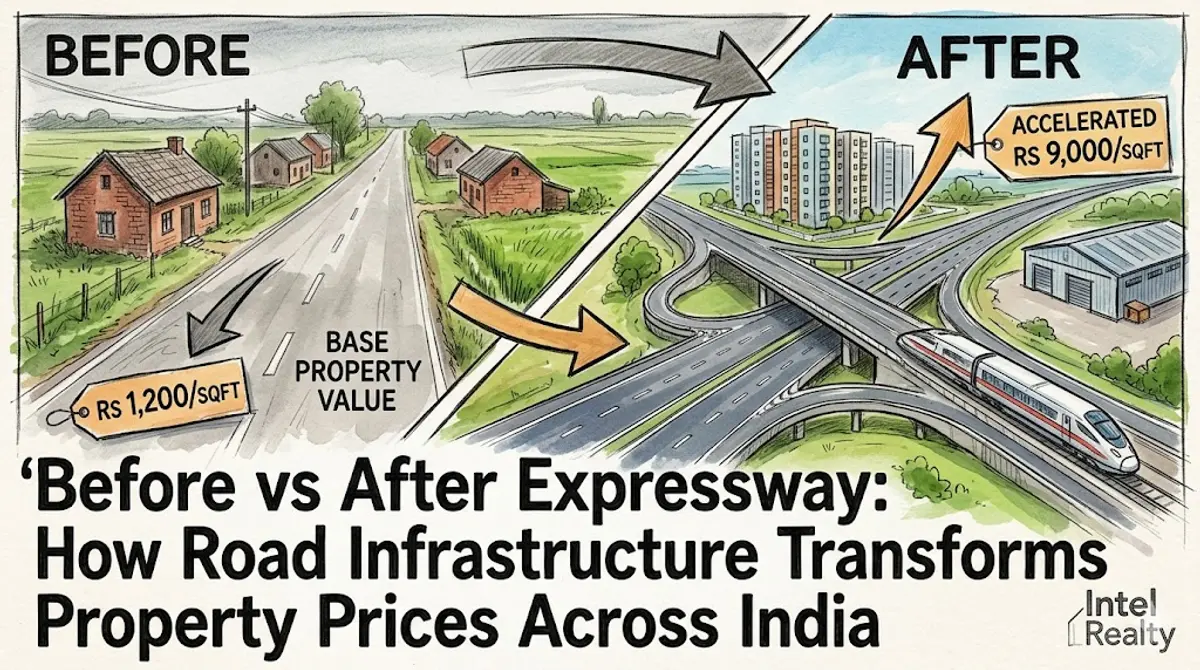
Before vs After Expressway: How Road Infrastructure Transforms Property Prices Across India
Before vs After Expressway: How Road Infrastructure Transforms Property Prices Across India
India's real estate market is deeply sensitive to infrastructure development. One of the most powerful triggers of property appreciation across the country is the announcement and completion of expressways. Whether it is the Yamuna Expressway, Purvanchal Expressway, Samruddhi Mahamarg, or the upcoming Bengaluru-Chennai Expressway, the pattern is consistent: properties located near expressway corridors witness dramatic price appreciation — often long before the road is even complete.
At Intel Realty, we have studied this trend across multiple markets in India. In this comprehensive guide, we break down the before vs after expressway property pricing phenomenon, what drives it, and how smart buyers and investors can leverage it.
Why Do Expressways Impact Property Prices?
Expressways do more than reduce travel time — they fundamentally reshape the economic geography of a region. When a new expressway is announced or constructed, it creates what urban planners call an 'infrastructure corridor effect.' This effect triggers a chain reaction:
Land along the corridor becomes accessible and valuable
Developers acquire land parcels in anticipation of future demand
Industries, logistics hubs, and warehouses set up operations nearby
Residential and commercial demand follows employment growth
Property prices escalate in multiple waves — at announcement, during construction, and post-completion
According to CREDAI and ANAROCK research, properties in expressway corridors have historically appreciated between 25% to 120% within 5 years of a project's completion, depending on location and connectivity benefits.
Phase-by-Phase Price Movement: The Expressway Property Lifecycle
Phase 1 — Pre-Announcement (Baseline Pricing)
Before any official announcement, land prices in rural or semi-urban areas along a future expressway route remain at agricultural or low-demand residential levels. In most parts of India, this translates to ₹500–₹2,000 per sq. ft. in the peripheral zones. These are the 'ground-floor' entry points that early investors and farmers hold.
Phase 2 — Announcement Phase (+15% to +35% Surge)
The moment the government officially announces an expressway project — whether through a budget allocation, environmental clearance, or land acquisition notice — property prices react immediately. Speculative buying begins, and brokers report a 15%–35% jump in enquiries and prices within the first 6–12 months of announcement.
This is historically the best time to invest, as prices are still relatively affordable and upside potential is highest.
Phase 3 — Construction Phase (+40% to +70% Cumulative Rise)
As expressway construction visibly progresses, confidence among buyers and investors grows. This phase typically sees the entry of branded developers who launch township projects, plotted developments, and integrated commercial zones. Prices can rise cumulatively by 40%–70% from the pre-announcement baseline during this phase.
Phase 4 — Completion and Operationalisation (+80% to +120%+)
Once the expressway opens and traffic flows, the region transforms. Connectivity to major cities becomes real, reducing commute times drastically. End-users — not just investors — now actively buy. This drives the most sustained and genuine demand, pushing prices 80%–120% above pre-announcement levels in prime pockets.
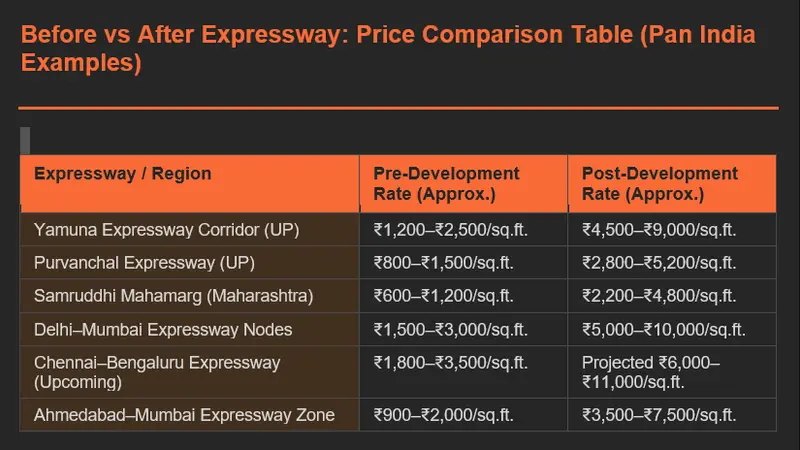
Note: Rates are indicative and vary by micro-market, proximity to interchange, and property type. Data compiled from industry reports, ANAROCK, and Intel Realty research (2024–2025).
Key Drivers Behind Expressway-Led Appreciation
1. Connectivity and Commute Reduction
The most direct driver is the drastic reduction in travel time. When a region that once took 3–4 hours to reach from a metro city becomes a 60–90 minute drive, it effectively becomes a viable residential or commercial destination. This fundamentally expands the market.
2. Industrial and Logistics Growth
Expressways attract industrial corridors, logistics parks, cold storage chains, and manufacturing clusters. These create local employment, which in turn drives housing demand. The Dedicated Freight Corridor and expressway combinations in states like Maharashtra and UP have made entire districts economically active.
3. Government Master Plan Alignment
Expressway routes are often integrated into state and national master plans, meaning they come with planned townships, smart city nodes, industrial estates, and government infrastructure. This policy backing dramatically reduces investment risk and boosts long-term confidence.
4. Developer and Institutional Interest
Large developers — Godrej Properties, DLF, Sobha, Prestige, and others — actively scout expressway corridors for project launches. When marquee developers enter a market, it signals credibility and draws end-user demand that was previously cautious.
3 Real-World Case Studies: Expressway & Property Appreciation
Case Study 1 — Yamuna Expressway, Uttar Pradesh
The Yamuna Expressway connecting Greater Noida to Agra transformed its flanking land from agricultural parcels priced at ₹1,200–₹1,800 per sq.ft. in 2012 to premium residential and commercial plots averaging ₹6,000–₹9,000 per sq.ft. by 2024. The development of Jewar Airport nearby further compounded appreciation. Investors who entered in 2012–2015 recorded 4x–5x returns in a decade. Sectors along the expressway — Sectors 16B, 18, 25 — saw the sharpest appreciation.
Case Study 2 — Samruddhi Mahamarg (Hindu Hrudaysamrat Balasaheb Thackeray Maharashtra Samruddhi Mahamarg), Maharashtra
This 701-km expressway connecting Nagpur to Mumbai opened in phases from 2022. Land prices along the Nagpur–Amravati stretch, which were ₹600–₹1,000 per sq.ft. before construction, rose to ₹2,200–₹4,500 per sq.ft. by 2024. Agri-land that was selling at ₹5–₹10 lakhs per acre pre-announcement is now commanding ₹30–₹55 lakhs per acre near major interchange nodes. Small investors who purchased plots of 1,000–2,000 sq.ft. near Igatpuri and Shirdi nodes have seen 200%+ appreciation.
Case Study 3 — Hyderabad Outer Ring Road (ORR), Telangana
The 158-km Outer Ring Road around Hyderabad is a blueprint case study in expressway-driven real estate. Areas like Shamshabad, Patancheru, Kompally, and Ghatkesar — which were peripheral and underdeveloped in 2010 — have evolved into sought-after residential markets. Property prices on the ORR periphery rose from ₹800–₹2,000 per sq.ft. in 2010 to ₹4,500–₹9,000 per sq.ft. in 2024 — a 4x–5x appreciation in 14 years. IT parks, logistics zones, and luxury townships now line the corridor.
What Buyers and Investors Must Evaluate
Not every expressway project delivers identical returns. Smart investors evaluate these critical parameters:
Proximity to interchange/exit point: Properties within 2–5 km of an interchange appreciate the fastest
Connectivity to employment hubs: Corridors linked to industrial estates or tech parks perform better
State government policy: States like Maharashtra, UP, and Telangana offer excellent buyer-friendly infrastructure policies
Project status: Active construction vs. land acquisition stage carries different risk-return profiles
Developer credibility: Branded developers entering the corridor signal mature market readiness
Legal clarity: Verify land use conversion from agricultural to residential/commercial before purchase
Internal Linking Suggestions
To strengthen this article's SEO performance and reduce bounce rates, the following internal links are recommended:
Link to: 'Top 10 Infrastructure Projects Transforming Real Estate in India 2025' — reinforces authority on infrastructure-driven investment
Link to: 'How to Evaluate a Plot Near an Upcoming Highway or Expressway' — captures mid-funnel investor intent
Link to: 'Expressway Corridor Properties Listed by Intel Realty' — drives direct conversion from informational to transactional intent
FREQUENTLY ASKED QUESTIONS
Q: How much can property prices increase after an expressway is built?
A: Property prices in expressway corridors across India have historically appreciated between 40% and 120% within 5 years of project completion. The exact appreciation depends on proximity to interchanges, connectivity to employment hubs, and the type of development along the corridor. Early investors who entered during the announcement phase have recorded the highest returns.
Q: Is it safe to invest in property near an under-construction expressway?
A: Investing during the construction phase is generally considered a calculated risk with high upside. The key is to verify land acquisition status, check for government approvals, ensure legal land-use conversion, and assess the developer's credibility. Under-construction phase investments typically offer 20%–40% lower entry prices than post-completion rates, making them attractive for medium to long-term investors.
Q: Which phase — pre-announcement or post-completion — offers the best property investment opportunity?
A: The pre-announcement and early announcement phases offer the best risk-adjusted entry points, as prices are still at or near baseline. However, this phase carries the highest uncertainty. Post-completion investments are safer but prices are already elevated. Most financial advisors recommend entering during the active construction phase as the optimal balance of price advantage and confirmed project viability.
Q: Do all areas along an expressway appreciate equally?
A: No. Appreciation is highly localized. Properties within 2–5 km of interchange points, toll plazas, or planned township nodes appreciate the fastest and the most. Areas mid-stretch without major access points may see moderate appreciation. Connectivity to the nearest metro city and presence of employers or industries nearby are critical differentiators.
Q: How does Intel Realty help investors identify the right expressway corridor properties?
A: Intel Realty's research team actively tracks expressway projects across India — from announcement to operationalisation. We map micro-markets, compare before and after pricing trends, verify legal status, and identify properties with the highest appreciation potential. Our pan-India network ensures clients get early access to credible, high-potential listings in expressway corridors across states.