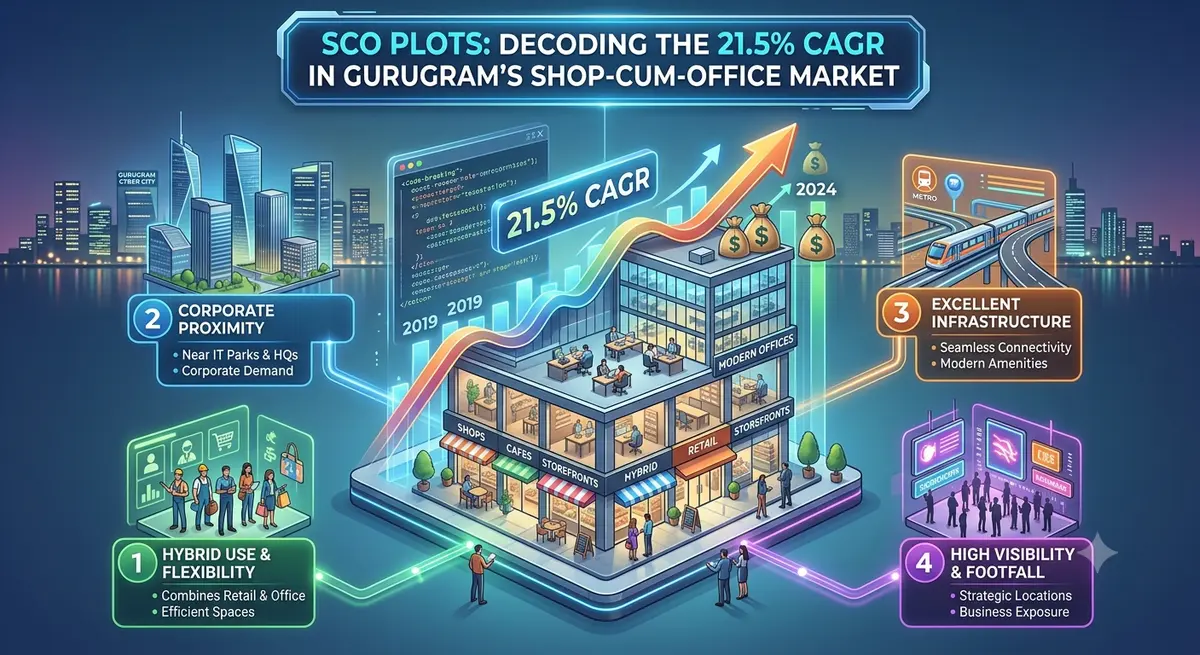
Gurugram SCO Plots Market Growth: Decoding 21.5% CAGR
The Structural Shift to Horizontal Commercial Real Estate
The retail and commercial real estate blueprint of Gurugram has fundamentally changed over the past five years. While the decade between 2010 and 2020 was defined by the relentless construction of vertical, strata-titled office towers and massive centralized indoor malls, the post-2021 corporate era has seen the rise of an alternative asset class: the Shop-Cum-Office (SCO) plot.
As we advance through 2026, institutional market indicators reveal a compelling narrative. While standard tier-1 commercial office yields across India have hovered within a predictable 7% to 10% range, Gurugram's plotted commercial ecosystem has outpaced national averages, logging a remarkable 21.5% Compound Annual Growth Rate (CAGR) in capital appreciation over the 2021–2026 cycle.
This horizontal commercial plotting model—highly promoted by the Directorate of Town & Country Planning (DTCP), Haryana—strikes a highly efficient balance between absolute land ownership and operational freedom. For institutional investors, high-net-worth individuals (HNIs), and family offices, the market is no longer driven by speculative momentum; it is backed by structural demand for high-street retail, low maintenance frameworks, and flexible, built-to-suit commercial architecture.
This comprehensive market breakdown decodes the financial, regulatory, and infrastructural forces driving this 21.5% CAGR, analyzing capital value growth across Gurugram’s primary economic corridors.
The Core Blueprint: Why the SCO Format Commands a Premium
To understand why capital is flowing rapidly into this sector, investors must evaluate the functional mechanics of the asset class. The traditional commercial real estate investment model forces buyers into strata-titled corporate units or mall retail spaces. In those formats, investors own only the indoor air space, remain dependent on long-term developer maintenance bodies, and face ongoing capital depreciation as the building ages.
The SCO model changes this dynamic by combining three essential investor advantages:
1. Freehold Land Ownership
Investors acquire 100% unencumbered ownership of the commercial land parcel. In an economy where urban land inside major metropolitan regions is highly scarce, owning a freehold commercial plot provides long-term capital protection and insulates the investor from building depreciation.
2. Multi-Level Structural Versatility (B+G+4 Framework)
DTCP-approved SCO guidelines typically allow for a highly efficient building footprint, offering a Floor Area Ratio (FAR) that can reach up to 4.3x of the plot size. Investors can construct a multi-level building featuring a basement, a premium ground-floor retail layout, and up to four upper stories. This configuration creates a diversified, multi-tenant revenue model:
- Basement & Ground Floor: Commands premium, high-footfall rental pricing from retail anchors, upscale cafes, or product showrooms.
- Upper Floors: Leased out to boutique corporate offices, diagnostic healthcare clinics, premium fitness centers, or upscale salons.
3. Minimal Maintenance Overhead Drag
Unlike glass-facade commercial complexes with centralized HVAC plants, grand multi-story atriums, and complex vertical transit systems that command hefty monthly maintenance fees, SCO markets feature highly efficient, low-maintenance common areas. This direct reduction in operational overhead helps protect net rental margins for the landlord.
Macro Data Analysis: Capital Value Trends (2021 vs. 2026)
The 21.5% CAGR seen across the Gurugram SCO ecosystem is driven by distinct infrastructure expansions and rising consumer demand within high-density residential catchments. The value growth is particularly visible along the city's key peripheral highway loops.
The following data matrix details the capital value evolution, typical plot dimensions, and baseline entry points across Gurugram's core SCO investment corridors:
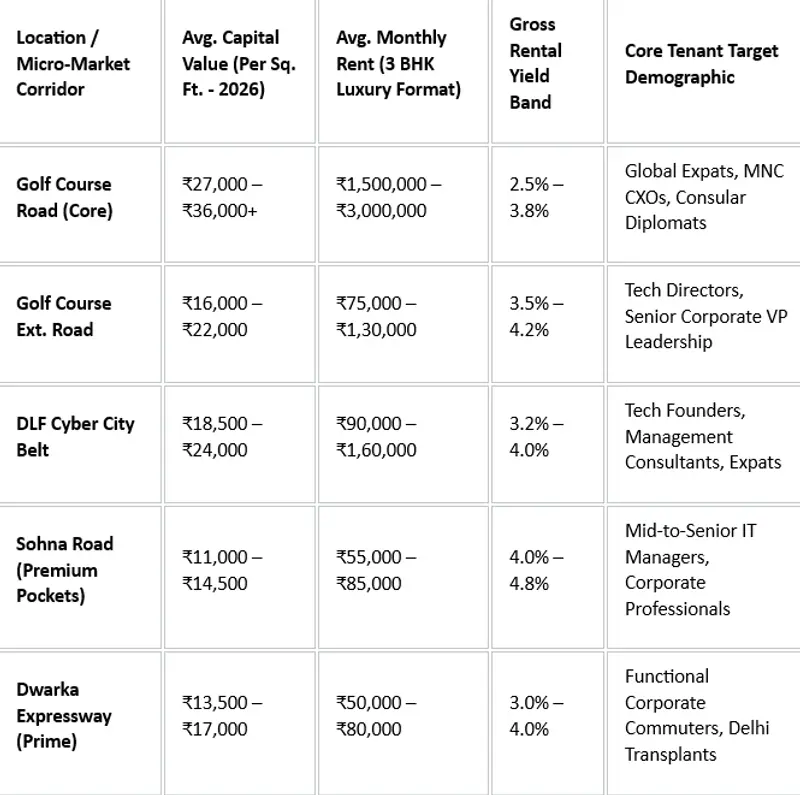
Key Takeaway from the Pricing Matrix
The data indicates that the Dwarka Expressway corridor—specifically Sector 114 and Sector 113—has led the appreciation wave with a localized CAGR of 23.4%. This strong performance is heavily supported by the 2026 circle rate revisions, which saw commercial land values adjust upward by up to 75% in emerging transit nodes, reflecting the rapid pace of physical infrastructure completion.
Geographic Analysis: The Epicenters of SCO Dominance
To build a high-performing commercial portfolio, investors must look past macro metrics and evaluate the distinct tenant dynamics shaping Gurugram’s core SCO hubs:
1. The Dwarka Expressway Northern Gateway (Sectors 113 & 114)
This micro-market functions as a critical economic link between New Delhi and Gurugram.
- The Catchment Synergy: Positioned immediately adjacent to the Delhi border, these sectors draw footfall from both affluent West/South Delhi residential neighborhoods and the expanding luxury high-rise communities along the expressway.
- Flagship Developments: Iconic projects like Emaar Business District (EBD 114) and M3M 114 Market have become high-performing commercial destinations. The proximity to Asia’s largest exhibition hub, Yashobhoomi (IICC), and the Diplomatic Enclave II complex provides long-term stability for luxury retail brands and upscale corporate showrooms.
2. The Southern Peripheral Road (SPR) Power Strip (Sectors 67 & 69)
The SPR corridor is rapidly establishing itself as a premier high-street commercial hub, supported by a dense base of over 200,000 local households.
- The Commercial Dynamic: Unlike deep peripheral markets, projects like DLF Central 67 and Whiteland Urban Cubes 71 are integrated into fully realized urban zones. The high concentration of premium gated residential communities ensures steady, non-cyclical consumer footfall for local retail blocks.
- The Asset Mix: The focus here centers on open-air, walk-through lifestyle hubs, matching the growing consumer preference for accessible high-street retail setups over traditional enclosed malls.
3. The New Gurgaon Economic Corridor (Sectors 88A, 89, & 95)
This corridor represents the entry-level institutional frontier for forward-looking commercial capital.
- Growth Catalysts: Value appreciation in this zone is anchored by the state government's 1,000-acre Global City project. New launches, such as India WorldMart in Sector 88A, offer approachable entry limits starting around ₹2.19 Crore, drawing interest from early-stage funds and corporate retail users looking to capture long-term value appreciation.
The Tenant Synergy Matrix: Why High Streets Outpace Traditional Malls
The impressive 21.5% CAGR in capital values is supported by a significant shift in tenant leasing preferences. High-street SCO configurations are increasingly outperforming traditional shopping malls across key performance metrics:
Tenant Value Flywheel in SCO Formats
[Zero Common Area Restrictions] ➔ [24/7 Operational Autonomy] ➔ [Direct Frontage Visibility] ➔ [Lower CAM Costs]
- Operational Autonomy and Footfront Control: Traditional malls impose rigid operating hours, centralized loading docks, and high Common Area Maintenance (CAM) charges that squeeze retail margins. SCO buildings provide brands with direct road visibility, independent entry lines, and 24/7 operational flexibility—factors that are highly prized by upscale restaurants, premium lounges, and modern fitness centers.
- Optimized Brand Visibility: The layout of an SCO market maximizes vehicular and pedestrian visibility. Brands can secure prominent exterior signage along major arterial transit lines, turning a standard commercial address into a powerful marketing asset.
Risk Mitigation Framework for Commercial Underwriters
While the growth metrics remain highly attractive, institutional asset managers must evaluate specific risk factors to maximize long-term portfolio performance:
- Navigating the Maturity Gap: The single most important factor for an SCO asset is its location within the wider market cycle. A plot located within an unproven, low-density sector can experience delayed footfall and extended initial vacancy windows. Investors requiring immediate, stable income should focus on established catchments, while those with an extended 5-to-7 year horizon can selectively look at emerging transit nodes to capture higher appreciation upside.
- Frontage and Plot Orientation Selection: In a high-street market layout, asset value is heavily driven by immediate visibility. Corner configurations, main boulevard exposures, and plots featuring dual-side access command substantial rental premiums over narrower interior plots.
- Regulatory Compliance Verification: Prior to deploying capital, underwriters must verify that the target commercial development possesses active DTCP approvals, clear zoning certificates, and explicit HRERA registrations to ensure a smooth, risk-mitigated construction path.
The Definitive Commercial Verdict
The institutional investment case for Gurugram’s SCO plots is firmly supported by structural market dynamics. The impressive 21.5% CAGR achieved over the past five years reflects a genuine market preference for freehold land control, multi-level revenue flexibility, and low-overhead high-street retail spaces.
As the city's key peripheral expressway loops reach full maturity, the opportunity to secure premium commercial plots within core high-density zones will naturally narrow. For institutional funds, family offices, and sophisticated private investors looking for a balanced mix of steady absolute cash flow and strong capital growth, the Gurugram SCO market stands out as a highly effective wealth-generation engine in the Indian commercial real estate landscape.
FAQ Section
1. What exactly does the term "SCO Plot" mean in Gurugram’s real estate framework?
An SCO (Shop-Cum-Office) plot is a freehold commercial land parcel situated within a master-planned, DTCP-approved commercial market layout. The buyer owns the underlying land parcel and the vertical structure outright, providing full development flexibility to build a multi-level commercial asset—typically featuring retail zones on the lower floors and corporate offices or services on the upper levels.
2. What specific factors drove the 21.5% CAGR in Gurugram's SCO market over the past five years?
This strong capital appreciation is driven by three main factors: the complete physical exhaustion of commercial land parcels in central urban hubs, the operational completion of major transit routes like the Dwarka Expressway and Central Peripheral Road, and a clear shift in consumer and tenant preference toward open-air, low-overhead high-street retail layouts over traditional indoor shopping malls.
3. What are the typical gross rental yields generated by completed SCO properties?
A fully built and occupied SCO development typically delivers combined gross rental yields ranging between 8% and 12% per year. The ground floor and basement levels command premium retail rents due to direct pedestrian footfall, while the upper stories generate steady commercial office returns, offering landlords multiple, resilient streams of income from a single property asset.
4. How does the building approval process operate for an SCO plot investment?
SCO plots are governed by clear, pre-approved building codes established by the DTCP, Haryana. Owners are permitted to construct structures that regularly feature a basement, a ground floor, and up to four upper levels (B+G+4), operating within pre-defined Floor Area Ratios (FAR) that can reach up to 4.3x the plot size, depending on the specific zone design.
5. What are the primary risks associated with investing in the SCO asset class?
The primary risk relates to localized infrastructure readiness and structural vacancy in newly launched, lower-density sectors. If an investor buys a plot in a peripheral market that lacks an immediate residential population, it can take several years for active retail footfall to develop. Investors can mitigate this risk by focusing on plots with prominent main-road frontage, clean land titles, and close proximity to proven residential catchments.