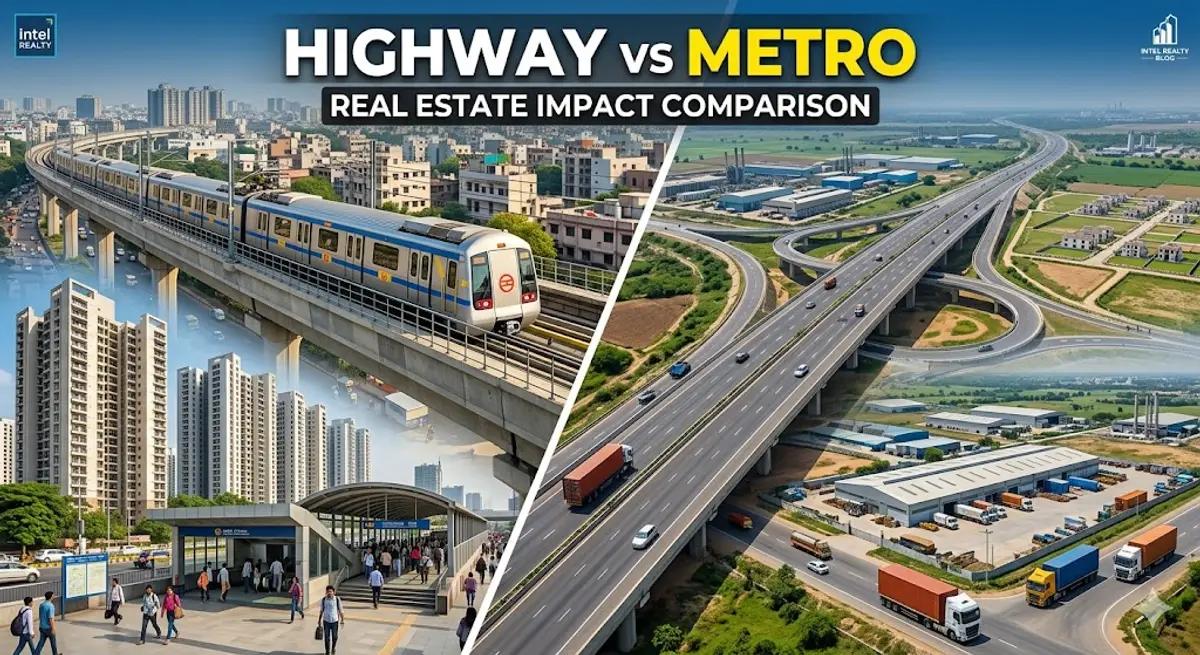
HIGHWAY vs METRO Real Estate Impact Comparison
HIGHWAY vs METRO Real Estate Impact Comparison
Highway vs Metro: Which Infrastructure Creates Greater Real Estate Returns in India?
It is one of the most common questions Intel Realty receives from property investors across India — should I buy near the new expressway or near the metro station? The question seems simple. The answer is not.
Both highways and metro lines have delivered transformational real estate returns in India. The Yamuna Expressway, the Mumbai-Pune Expressway, and the Hyderabad ORR are legendary expressway appreciation stories. The Delhi Metro Blue Line in Dwarka, Bengaluru's Purple Line corridor, and Hyderabad's HITEC City metro zone are equally celebrated metro stories. But the returns, the timelines, the asset types, and the risk profiles are fundamentally different — and confusing one for the other is one of the most common and costly mistakes Indian property investors make.
This guide provides a rigorous, data-backed comparison of highway and metro infrastructure across every dimension that matters for real estate investors — appreciation magnitude, appreciation radius, asset type suitability, timing sensitivity, risk profile, and the scenario where one consistently outperforms the other. The goal is not to declare a winner. The goal is to give you the framework to choose correctly for your specific investment context.
INTEL REALTY RESEARCH
Across 22 infrastructure corridors studied between 2010 and 2024, highway-adjacent land delivered higher absolute returns over 10-year holds, while metro-adjacent residential delivered higher risk-adjusted returns over 5-year holds. The optimal strategy — where geographically possible — is to combine both exposures in a single investment decision.
Highway vs Metro: The Head-to-Head Comparison
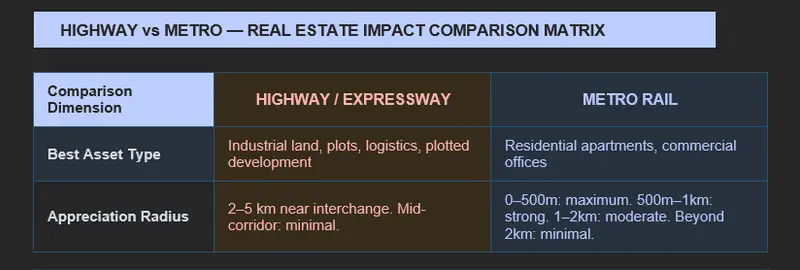
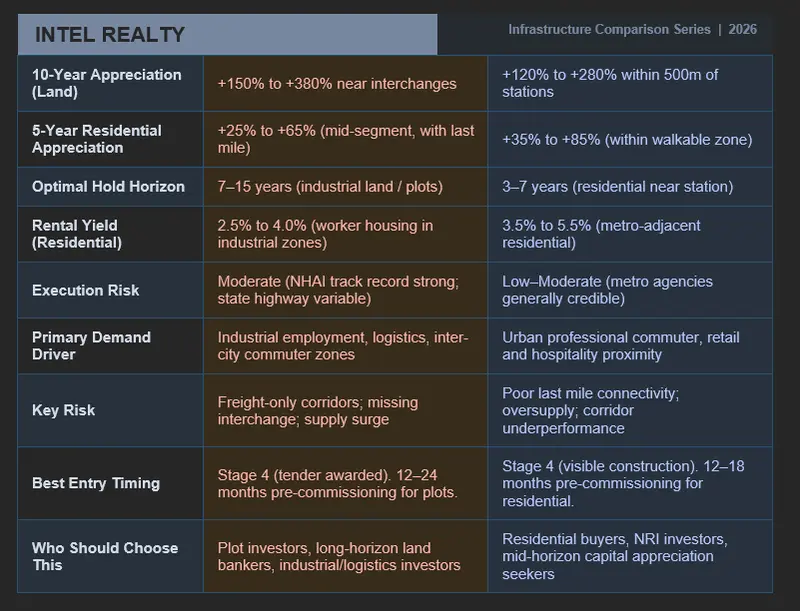
Before examining the nuances, here is Intel Realty's direct comparison across the dimensions that matter most for real estate investment decisions.
When Highway Infrastructure Consistently Outperforms Metro
There are specific scenarios where highway infrastructure is demonstrably the stronger real estate investment catalyst — and knowing them helps investors avoid reaching for metro-adjacent properties when the highway opportunity is clearly superior.
Industrial and Logistics Land Investment
For industrial plots, warehousing land, and logistics park development, highway proximity trumps metro proximity every time. Industrial operators need road connectivity for trucks, containers, and raw material movement — not rail commuter access. The Hyderabad ORR, the DMIC WDFC belt, and the Bengaluru PRR industrial nodes have all delivered industrial land appreciation of 200 to 400% over a decade — returns that no metro-adjacent industrial zone can match, because metros serve people, not freight.
Long-Horizon Land Banking
For investors with 7 to 15 year hold horizons willing to bank land in peri-urban and peripheral zones, highway corridors — particularly expressways — deliver higher absolute returns than metro corridors. This is because highways reach further into lower-priced land zones, enabling entry at fundamentally lower cost per square yard. The step-change re-rating from agricultural/peri-urban to highway-accessible land creates appreciation multiples that are structurally unavailable in the higher-baseline-priced zones that metro lines typically pass through.
Tourism and Hospitality Corridors
In corridors connecting major cities to tourism destinations — the Mumbai-Pune Expressway driving Lonavala, the Yamuna Expressway driving Mathura-Vrindavan, and NH-44 driving Coorg — highway connectivity is the sole relevant infrastructure catalyst. Tourism demand for hospitality and second-home residential is driven by driveable weekend access, not metro proximity. No metro line has created a Lonavala or a Vrindavan. Expressways have.
When Metro Infrastructure Consistently Outperforms Highways
Metro lines deliver superior real estate returns in a specific but very important set of scenarios — and these scenarios include the most common residential investment use case for urban buyers in India's major cities.
Urban Residential Apartments
For mid-segment and premium residential apartments in urban and peri-urban zones, metro proximity consistently outperforms highway proximity. The reason is simple: apartment buyers in cities care about their daily commute above all other location factors — and a metro station is a daily commute solution. A highway reduces weekend travel time. The daily utility premium that metro connectivity commands in residential pricing is structurally higher and more durable than any highway proximity premium for the same apartment buyer demographic.
Short-to-Medium Hold Horizons
Metro corridors deliver their appreciation in a more compressed timeframe — typically 3 to 7 years from pre-commissioning entry to post-commissioning maturation. Highway appreciation can take 7 to 15 years to fully play out through industrial seeding, residential demand buildup, and corridor maturation. For investors with shorter hold horizons or capital that needs to recycle within a defined period, metro-adjacent residential investment offers faster liquidity and more predictable exit timing.
Rental Yield Optimisation
Metro-adjacent residential properties command superior rental yields compared to highway-adjacent residential — consistently 1 to 2 percentage points higher in comparable markets. This is because urban professionals who rely on metro commuting are willing to pay a meaningful premium for walkable metro access. For investors seeking income alongside capital appreciation, metro proximity delivers a better yield profile than highway proximity for the residential asset class.
The Convergence Premium: When Both Intersect in the Same Zone
The most powerful real estate appreciation zones in India are not where highway OR metro infrastructure is excellent — they are where both converge. Properties that sit within reach of both a metro station and a highway interchange consistently outperform single-infrastructure zones by 40 to 60% over a 7-year hold period in Intel Realty's tracked corridors.
These convergence zones exist in every major Indian city and are the highest-priority investment locations on Intel Realty's pan-India opportunity map. In Delhi NCR, the Dwarka Expressway-metro intersection zones have delivered both transit-commuter residential demand and highway-accessible industrial demand simultaneously. In Hyderabad, the ORR-metro interchange zones command premiums that neither the ORR nor the metro alone would justify.
INTEL REALTY CONVERGENCE ZONES 2025
Current high-priority convergence zones where both highway and metro infrastructure intersect: Jewar Corridor (Yamuna Expressway + RRTS + DFC); Bengaluru PRR-Metro Phase 2 intersection (Hoskote zone); Hyderabad ORR-metro interchange (selected stations); Chennai ORR-suburban rail intersection (Sriperumbudur approach); Navi Mumbai Airport zone (highway + metro extension + airport — triple convergence).
3 Case Studies: Highway vs Metro in Direct Competition
01
NCR: Same Geography — Highway vs Metro, Very Different Outcomes
CLIENT VOICE
"I had the same budget in 2016. My colleague bought a residential flat near the Eastern Peripheral Expressway — highway-adjacent. I bought near a Dwarka metro station. By 2022, his flat had appreciated 14%. Mine had appreciated 58%. Same city, same period, same budget. Infrastructure type made all the difference." — Residential Buyer, Delhi NCR
The NCR provides one of the clearest natural experiments in highway versus metro real estate performance. The Eastern Peripheral Expressway (KMP) and the Delhi Metro Blue Line/Dwarka corridor both serve peripheral NCR zones — yet their residential real estate performance between 2015 and 2022 diverged sharply. Metro-adjacent residential within 800 metres of Blue Line stations in Dwarka appreciated 45 to 65%. Highway-adjacent residential near the KMP without direct metro access appreciated 10 to 20%.
The divergence is explained by asset type mismatch. The KMP is a freight-dominant highway — its primary value creation is in industrial and logistics land, not residential apartments. Buyers who purchased residential property based on highway proximity missed this critical distinction. Metro-adjacent buyers in Dwarka got exactly the infrastructure their asset type needed: daily commuter connectivity to central Delhi employment. The lesson is not that highways are bad — it is that asset type must match infrastructure type.
KEY TAKEAWAYMatching asset type to infrastructure type is the most important single decision in infrastructure-linked real estate investment. Residential buyers need daily commuter infrastructure. Industrial buyers need freight connectivity. Confusing the two destroys returns.
02
Hyderabad: ORR vs Metro — When Highway Wins for Land, Metro Wins for Apartments
CLIENT VOICE
"I tracked both the Hyderabad ORR and the metro in the same period. My industrial land near the ORR has given 4x in 10 years. My colleague's residential apartment near HITEC City metro has given 2.5x in 7 years — better annualised return. We both won. We just invested in the right asset for the right infrastructure." — Dual Investor, Hyderabad
Hyderabad presents the clearest pan-India illustration of how highway and metro infrastructure serve different real estate asset classes rather than competing directly. The Hyderabad ORR has delivered extraordinary industrial land appreciation — 200 to 300% over a decade — in its interchange zones. The HITEC City metro corridor has delivered strong residential and commercial appreciation — 65 to 85% over 7 years — near operational stations. Both are genuine successes. Neither is superior in absolute terms.
What determines the winner is asset type selection. Industrial land on the ORR generated higher absolute rupee returns over 10 years — because the capital entry price was lower and the industrial demand re-rating was larger in percentage terms. Residential apartments near the metro generated better annualised returns over 7 years with lower entry cost, faster liquidity, and better rental yields during the holding period. Sophisticated Hyderabad investors captured both opportunities simultaneously — industrial land on the ORR and residential apartments near the metro — treating them as complementary rather than competing investments.
KEY TAKEAWAYHighway and metro infrastructure are not competing alternatives. They are complementary catalysts for different asset types. A balanced portfolio strategy uses both — land on the highway, apartments on the metro.
03
Bengaluru: PRR + Metro Phase 2 Intersection — The Convergence Premium in Action
CLIENT VOICE
"Intel Realty identified the Hoskote PRR-Metro Phase 2 intersection zone in 2022. The story was simple: the Peripheral Ring Road was bringing industrial demand. The metro extension was bringing commuter residential demand to the same geography. We entered plotted development at Rs. 3,400 per sq.ft. By 2025 it is quoted at Rs. 5,600. Neither infrastructure alone would have created this." — Portfolio Investor, Bengaluru
The Hoskote zone in eastern Bengaluru sits at the intersection of the Peripheral Ring Road and the planned Bengaluru Metro Phase 2 extension. When Intel Realty identified this zone in 2022, both infrastructure elements were at Stage 3 or 4 — credible, confirmed, and within 18 to 36 months of commissioning. The dual infrastructure convergence created two simultaneous demand drivers: industrial employers relocating to the PRR corridor needed their workforce housed nearby, while metro commuters gained access to Bengaluru's tech employment zones from Hoskote for the first time.
The result was a convergence premium that neither infrastructure alone could have justified. Industrial-driven demand would have supported plotted development at Rs. 2,800 to 3,200 per sq.ft. Metro-driven demand would have supported residential apartments at Rs. 3,200 to 3,800 per sq.ft. The intersection of both — creating a location that serves both industrial workforce housing and metro commuter residential — pushed the effective market price to Rs. 5,400 to 5,800 per sq.ft by 2025, delivering 60 to 70% appreciation in 3 years.
KEY TAKEAWAYConvergence zones — where highway and metro infrastructure intersect — deliver returns that exceed what either catalyst would create independently. Identifying these zones before the market fully prices in the dual catalyst is the highest-conviction play in infrastructure-linked real estate.
The Decision Framework: Highway or Metro for Your Specific Situation
Use this Intel Realty framework to determine which infrastructure type best serves your investment goals:
Choose HIGHWAY if: You are investing in industrial plots, logistics land, or warehousing development; your hold horizon is 7 years or more; you are targeting peri-urban or peripheral zones where land prices are still sub-Rs. 20,000 per sq.yard; or the corridor connects major manufacturing or export hubs.
Choose METRO if: You are investing in residential apartments or commercial offices; your hold horizon is 3 to 7 years; you need rental yield above 3.5% during the holding period; or the station catchment serves high-density urban professional employment.
Choose CONVERGENCE ZONE if: You can find a location within 5 km of both a highway interchange AND a metro station or planned station; budget allows entry before one or both infrastructure elements are commissioned; and you can hold for 5 to 8 years through both commissioning events.
Verify last mile connectivity: For metro investment, confirm feeder bus, e-rickshaw, and walkability quality. Poor last mile access can reduce metro-station proximity to near-zero value for residential buyers.
Verify traffic profile for highways: Confirm the highway serves commuter traffic — not only freight. A freight-dominant highway delivers industrial land appreciation, not residential appreciation.
Always verify execution stage: Both highway and metro investments require Stage 4 entry at minimum — tender awarded, physical construction visible — before committing residential or plotted development capital.
INTEL REALTY PRINCIPLE
The wrong question is 'highway or metro?' The right question is 'what asset type am I buying, and which infrastructure type serves that asset's daily utility?' Residential apartments need commuter infrastructure. Industrial land needs freight infrastructure. Ask the second question and the first one answers itself.
FREQUENTLY ASKED QUESTIONS
FAQ: Highway vs Metro Real Estate Impact Comparison in India
Q1—Does a highway or a metro line increase property values more in India?
Neither is universally superior — it depends on asset type, location context, and hold horizon. Highway infrastructure delivers higher absolute appreciation for industrial land and plots over 10-year holds — typically 150 to 380% near interchanges. Metro infrastructure delivers better risk-adjusted returns for residential apartments over 5-year holds — consistently 35 to 85% within 500 metres of operational stations. Residential buyers generally benefit more from metro access; industrial and land investors generally benefit more from highway access. The optimal scenario is a convergence zone where both intersect, which Intel Realty's research shows outperforms either single catalyst by 40 to 60%.
Q2—How far from a metro station should I buy property for maximum appreciation?
The metro appreciation gradient is steep. Properties within 500 metres of a metro station consistently deliver the highest appreciation — 35 to 85% in 5 years in well-performing corridors. Between 500 metres and 1 km, the premium is still meaningful. Between 1 and 2 km, it diminishes significantly, especially if last mile connectivity is poor. Beyond 2 km, the measurable metro premium on residential properties is near-zero in most Indian markets. Additionally, ensure last mile quality — feeder buses, e-rickshaws, and walkability — before relying on the 500-metre distance alone. A 600-metre walk on a broken footpath to a metro station is not equivalent to a 600-metre walk on a safe, lit footpath.
Q3—How far from a highway should I buy property for maximum returns?
For highway investment, proximity gradient is defined by interchange access rather than raw distance. Properties within 2 to 5 km of a highway interchange consistently capture the highest appreciation — because interchange zones attract the industrial, commercial, and residential demand that proximity to the highway itself creates. Mid-corridor locations more than 5 km from the nearest interchange capture minimal highway value regardless of how close they appear to the highway on a map. High-speed highways also create noise and pollution externalities that reduce residential desirability for properties immediately adjacent to the highway itself — the sweet spot for residential is 300 metres to 3 km from the highway with direct interchange access.
Q4—Which is better for residential investment — highway adjacent or metro adjacent?
For residential apartments and mid-segment housing, metro-adjacent investment consistently outperforms highway-adjacent investment on rental yield, liquidity, and medium-term capital appreciation. The reason is daily utility: a metro station solves the everyday commute problem that determines where urban professionals choose to rent and buy. A highway reduces weekend travel time but does not substitute for metro commuting in a congested city. The only exception is when the highway corridor has strong last mile connectivity that enables daily commuting — in which case highway-adjacent residential in lower-priced zones can deliver superior returns for buyers willing to tolerate longer commute times in exchange for lower entry prices.
Q5—How does Intel Realty identify convergence zones where both highway and metro drive appreciation?
Intel Realty maintains a live infrastructure convergence map across India's major metros and tier-2 cities, tracking every planned and operational highway, metro, RRTS, and freight corridor alignment. We identify convergence zones — where two or more infrastructure elements are within 5 km of each other at Stage 3 or 4 execution — and classify them by convergence type (highway + metro, highway + airport, metro + DFC terminal, etc.). Each convergence type creates a different demand character and asset recommendation. We actively surface convergence zone investment opportunities to clients before commissioning events, when the convergence premium is still available at pre-market-recognition entry prices.