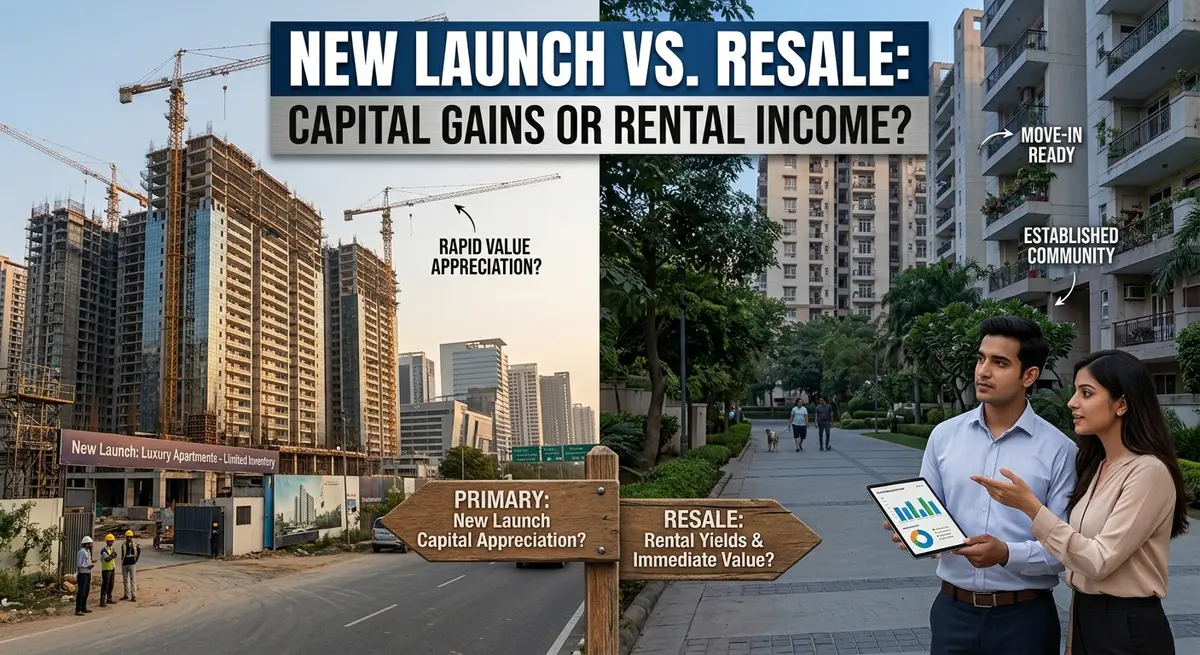
Primary vs Resale in Gurugram: Which Gives Better Gains?
Primary vs. Secondary: Analyzing Capital Gain Potential in Gurugram's Resale Market
Every investor entering Gurugram's property market eventually faces the same decision: book an under-construction flat from a developer (primary market), or buy an existing, ready property from a current owner (secondary/resale market). The choice affects your entry price, your holding period, your tax outgo, and ultimately, your capital gains.
Gurugram's resale market has matured significantly. With Delhi-NCR posting 30% year-on-year sales growth and Gurugram alone contributing nearly 73% of the region's new launches, both segments are active — but they don't behave the same way.
Primary vs. Secondary: What Actually Separates Them
The primary market covers fresh bookings directly from developers — units still under construction or newly launched. The secondary market covers resale transactions, where an existing owner sells a ready or near-ready property to a new buyer.
The core trade-off is time versus certainty. Primary buyers commit capital years before possession, betting on future infrastructure and price appreciation. Secondary buyers pay a premium for a tangible, inspectable, ready-to-move asset — but they enter after much of the early appreciation curve has already played out.
Capital Appreciation: Comparing the Two Tracks
Primary Market Gains
Under-construction projects are typically priced 10–30% below comparable ready units in the same micro-market. In high-growth corridors, the gap between booking price and possession-time value has reached 30–40%. Dwarka Expressway is the textbook example: once the road became fully operational, prices in previously peripheral sectors climbed sharply, and early bookers are now sitting on substantial paper gains.
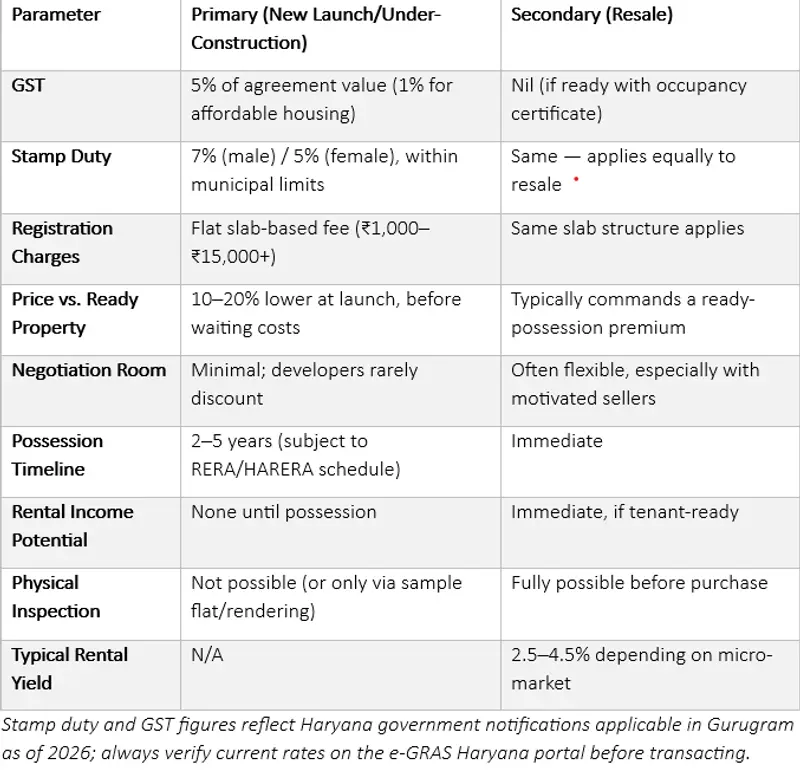
The catch is patience and risk. Construction delays, developer financial health, and infrastructure execution timelines all sit between your booking and your payout. Buyers must also budget for 5% GST on the agreement value (1% for affordable housing units), which adds real cost on top of the base price.
Secondary Market Gains
Resale performance in established corridors has been just as strong, only spread over a longer, already-realized timeline:
- Golf Course Road has appreciated roughly 65–80% since 2019, driven by scarcity of land and consistent demand from senior executives and expatriates.
- Golf Course Extension Road has moved from around ₹8,800 per sq ft in 2019 to upwards of ₹20,000 per sq ft currently.
- Southern Peripheral Road (SPR) has recorded close to a 125% jump over three years, positioning it as an emerging alternative to Cyber City given its NH-48 access.
- Localities such as Sector 105, NH-8, and Maruti Kunj rank among the highest three-year appreciators in the city on transaction-tracking platforms, with gains reported well above 150%.
Resale buyers benefit from zero GST (only stamp duty and registration apply), immediate rental income potential, and the ability to physically inspect the asset and negotiate price — something new-launch buyers almost never get.
Cost Comparison: Primary vs. Secondary Purchase in Gurugram
Where Resale Outperforms — and Where It Doesn't
In established, land-scarce corridors like Golf Course Road, DLF Phase 5, and central sectors, resale is often the smarter capital-gains play. Supply is limited, infrastructure is complete, and prices already reflect a track record of appreciation with lower execution risk.
In emerging corridors like Dwarka Expressway, New Gurgaon (Sectors 84–113), and parts of SPR, the primary market has historically delivered sharper gains — precisely because these areas were repriced upward as infrastructure was delivered. Investors entering now via resale in these belts are buying after a large part of that repricing has already happened, though further gains are still expected as metro connectivity and the Global City project progress.
Risk Factors Investors Should Weigh
Before choosing either path, factor in:
- Shadow inventory risk — a wave of investor-held units hitting resale simultaneously in sectors like 84 or 102 could temporarily cap price growth.
- Last-mile infrastructure lag — main expressways may be ready, but internal sector roads, water, and sewage in newer pockets are still catching up.
- RERA/HARERA compliance — always verify a developer's Quarterly Progress Report status and Registration Certificate validity on the HARERA Gurugram portal before booking primary inventory.
Who Should Choose What
- First-time homebuyers prioritizing certainty and immediate move-in typically favor resale in established sectors.
- Growth-focused investors with a 3–5 year horizon often lean toward primary bookings in infrastructure-linked corridors.
- NRIs frequently prefer resale for the ability to conduct remote due diligence through documented ownership history, avoiding construction-risk exposure from abroad.
Final Verdict
Neither market is universally superior — the right choice depends on your holding period, risk appetite, and target corridor. Resale offers lower risk, immediate returns, and negotiation leverage in mature locations. Primary offers higher theoretical upside in emerging corridors, at the cost of construction risk and GST. A disciplined investor typically blends both: resale for stability, primary for calculated growth bets in corridors with visible infrastructure execution.
FAQ Section
1. Is resale property in Gurugram cheaper than a new launch?
Generally, yes, for the same location — new launches are sometimes quoted 10–20% lower at pre-launch, but this doesn't account for GST, waiting time, and construction risk, which often closes or reverses the gap.
2. Does GST apply to resale properties in Gurugram?
No. GST applies only to under-construction properties (5%, or 1% for affordable housing). A ready resale flat with an occupancy certificate is exempt from GST.
3. Which gives better capital gains — primary or resale property in Gurugram?
It depends on the corridor. Emerging areas like Dwarka Expressway have historically rewarded early primary bookings, while established corridors like Golf Course Road have delivered strong, lower-risk gains through resale.
4. What is the average rental yield on resale property in Gurugram?
Residential resale properties in Gurugram typically yield 2.5–4.5% annually, with premium micro-markets near Cyber City and Golf Course Extension Road on the higher end.
5. Is it safe for NRIs to invest in Gurugram's resale market?
Yes, resale is often preferred by NRIs since the property, its title history, and occupancy status can be verified before purchase, reducing the construction and developer-risk exposure inherent in primary bookings.
6. What stamp duty applies when buying a resale property in Gurugram?
The same rates apply to both primary and resale transactions: 7% for male buyers and 5% for female buyers within municipal limits, plus registration charges, calculated on the higher of transaction value or circle rate.